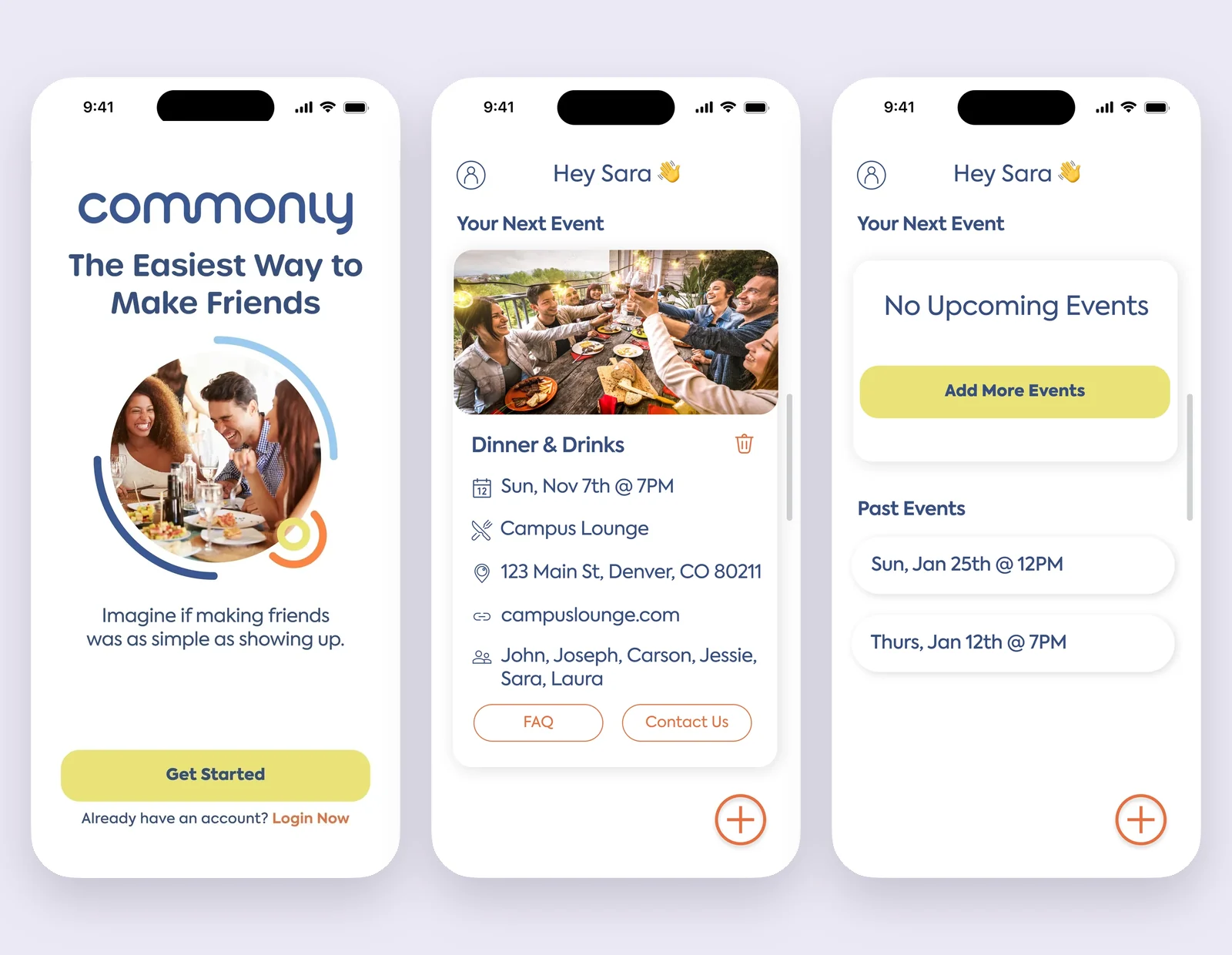
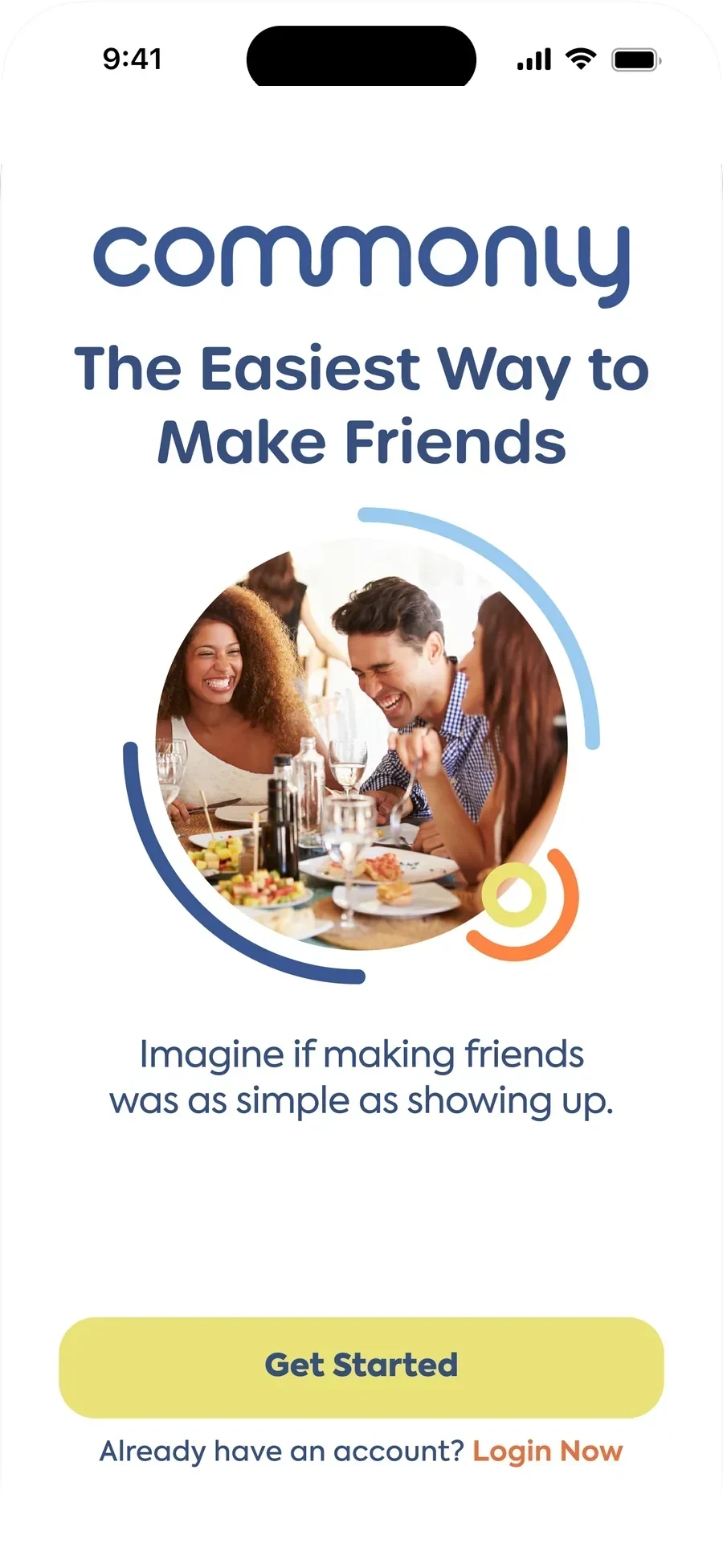
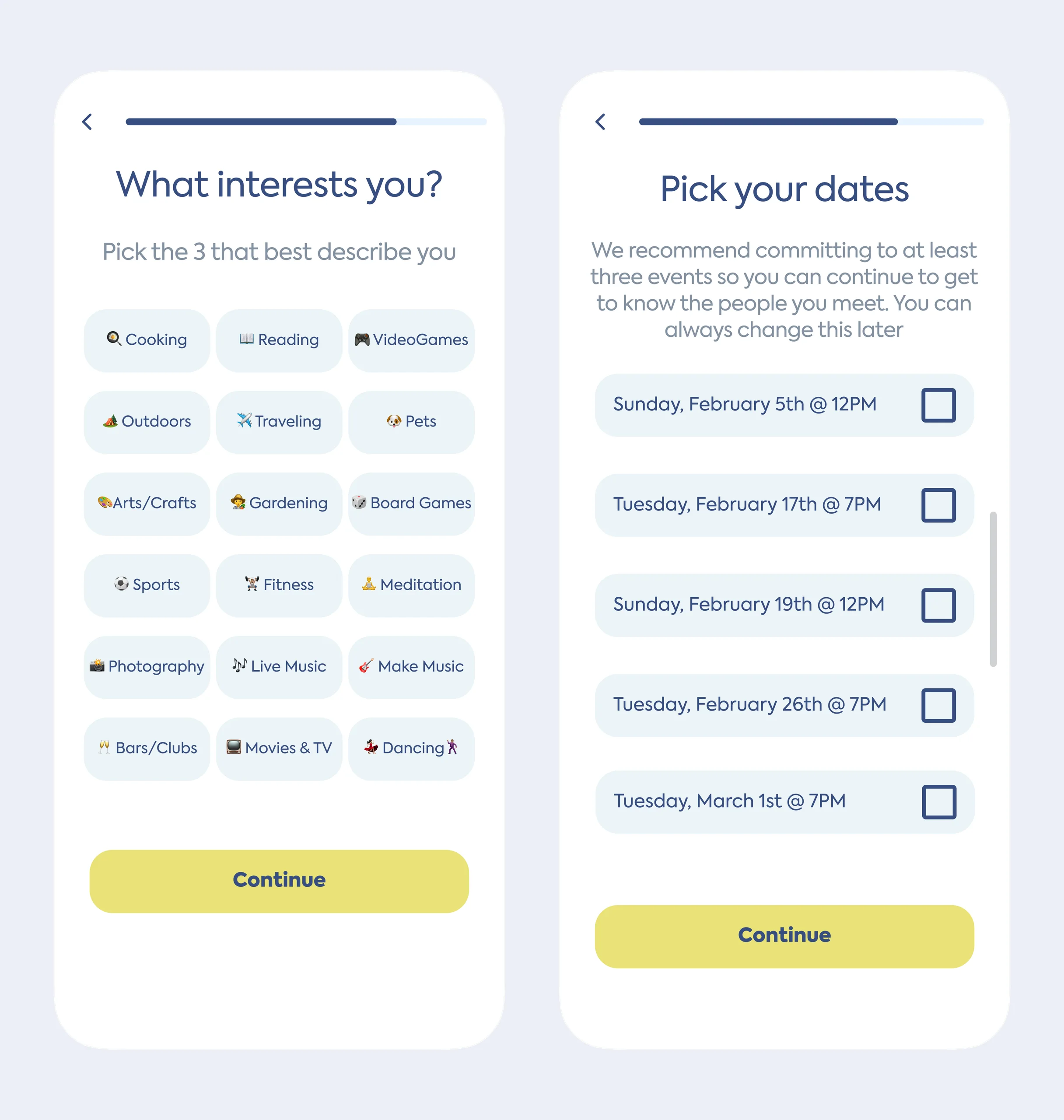
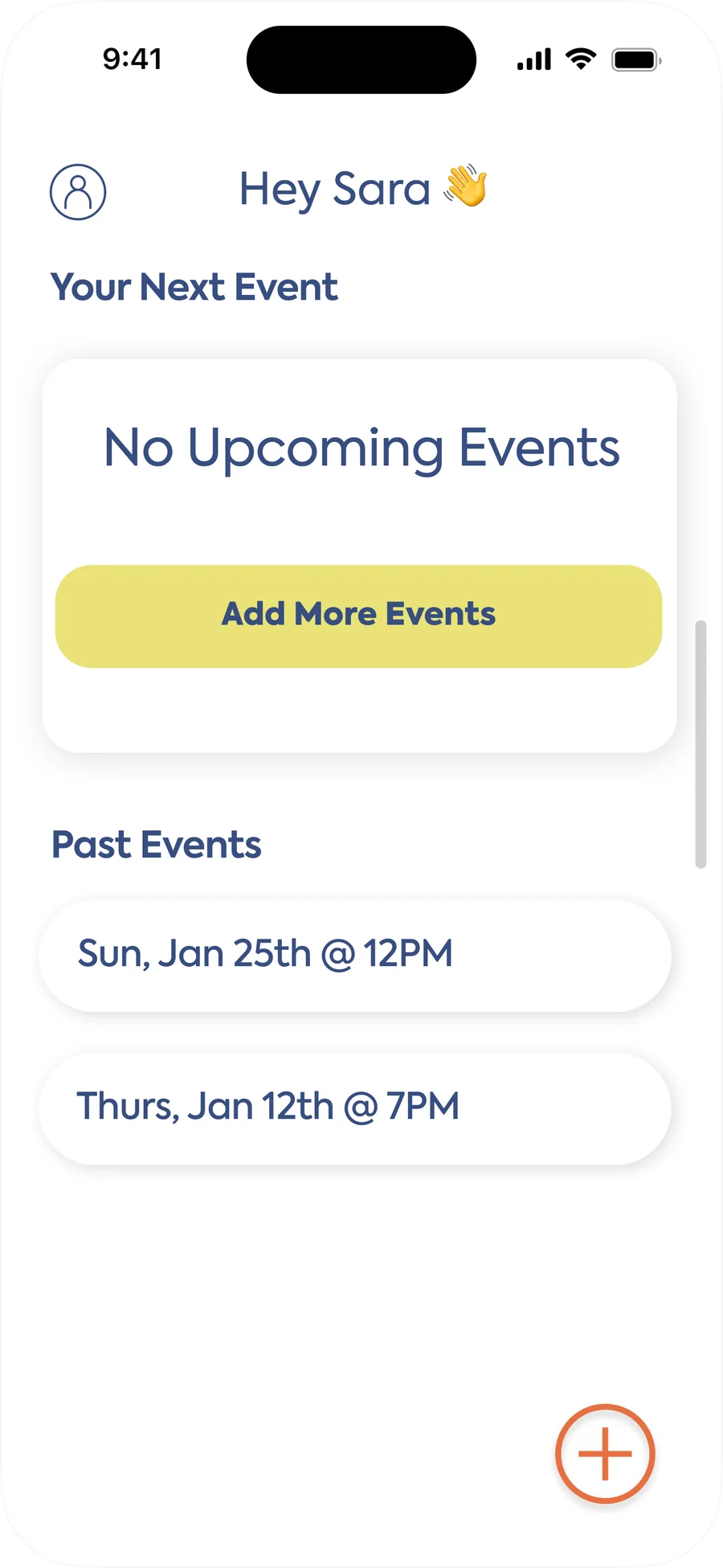
Commonly matches strangers into small dinner groups. I led product design from zero to launch, and reframed the problem from “who should meet” to “what makes people come back.”
RoleProduct Designer, sole designer
TeamFounder, 2 engineers, ops lead
I ownedAll product design: strategy, brand and design system, iOS app
PlatformiOS app
Problem
Friend apps optimize for matches. But a match is worthless if nobody shows up twice.
What I did
Mapped the path from sign-up to friendship, found where it breaks, and designed a lever for each break.
Impact
34% → 71%
second-event bookings
Second-event bookings rose from 34% to 71%. No-shows fell from 17% to 6%.
The insight
“Friendship isn’t a matching problem. It’s a follow-through problem.”
The sentence that changed the roadmap.
No swiping✦Commit to three✦Reveal late✦Mutual or nothing✦No swiping✦Commit to three✦Reveal late✦Mutual or nothing✦No swiping✦Commit to three✦Reveal late✦Mutual or nothing✦No swiping✦Commit to three✦Reveal late✦Mutual or nothing✦
01Reframe
The brief said “match people better.” The data said something else.
Early beta groups rated dinners highly, yet most people never booked a second one. Better matching would not fix that. Repetition would.
Original framing
How might we match people who will get along?
Leads to: richer profiles, smarter algorithms, more choice.
Reframed
How might we get people to see the same faces again?
Leads to: commitment, anticipation, closure, mutual consent.
~50 hrsTime it takes to go from acquaintance to casual friend, according to research by Jeffrey Hall at the University of Kansas. One dinner is about three.
Before: a table set for six, used by one.
↑ One dinner ≈ 3 hrsCasual friend ≈ 50 hrs →
One great night fills one block. The product had to be about filling the rest.
02Funnel
I mapped five stages between a stranger and a friend.
Each stage has a moment where people quietly drop off. Every design decision on this page targets one of them.
Stage 1Sign upBreaks when the product sounds like a dating app.Lever: Onboarding that answers doubts first.
Stage 2Show upBreaks when dinner is weeks away and easy to forget.Lever: Countdown and a late reveal.
Stage 3Come backBreaks when one okay night feels like enough.Lever: Commit to three dates up front.
Stage 4Say yesBreaks when choosing feels awkward or one-sided.Lever: Private, mutual-only signals.
Stage 5StayBreaks when there is nowhere to continue.Lever: Group chat, then friends.
Illustrative beta drop-off. Stages 2 and 3 lost the most people, so they got the most design attention.
The goal: six strangers, one table, a reason to keep talking.
H1
We believe asking for three events up front will feel like a bigger ask but double repeat attendance.
WE’LL KNOW IF members with three dates booked attend more events than those with one.
H2
We believe hiding profiles will lower anxiety, not trust.
WE’LL KNOW IF sign-up completion holds, and no-shows stay low.
H3
We believe a required survey is acceptable if it is short and pays off.
WE’LL KNOW IF completion stays above 80% without support complaints.
03Decisions
Five decisions, and the options I said no to.
D1Decision
No browsing. Ever.
The question: Should people see who they will meet before they commit?
Option ABrowse profiles and pick a groupFamiliar, but it recreates swipe culture and judging by photo.
Option BShow blurred previewsFelt like a tease. Testers fixated on the blurred faces.
Option CCHOSEN
Private profiles, team curatesRemoves judgement. Trust shifts to the brand.
Tradeoff I acceptedI gave up a familiar “control” moment. Onboarding had to earn that trust instead.
Signal I watchedSign-up completion and first-event attendance.
D2Decision
Ask for three, not one.
The question: How big a commitment can we ask for at sign-up?
Option ABook one event at a timeLow friction, but it made every event a fresh decision.
Option BCHOSEN
Three dates, recommendedA nudge, not a wall, backed by the “no match in three, next month free” guarantee.
Option CMandatory three-event bundleToo heavy for a brand-new product.
Tradeoff I acceptedA longer sign-up. I softened it with a guarantee rather than removing the ask.
Signal I watchedEvents booked per member in the first month.
D3Decision
Reveal late, on purpose.
The question: When should people learn the venue and who is coming?
Option AEverything at bookingGives people weeks to overthink it and cancel.
Option BCHOSEN
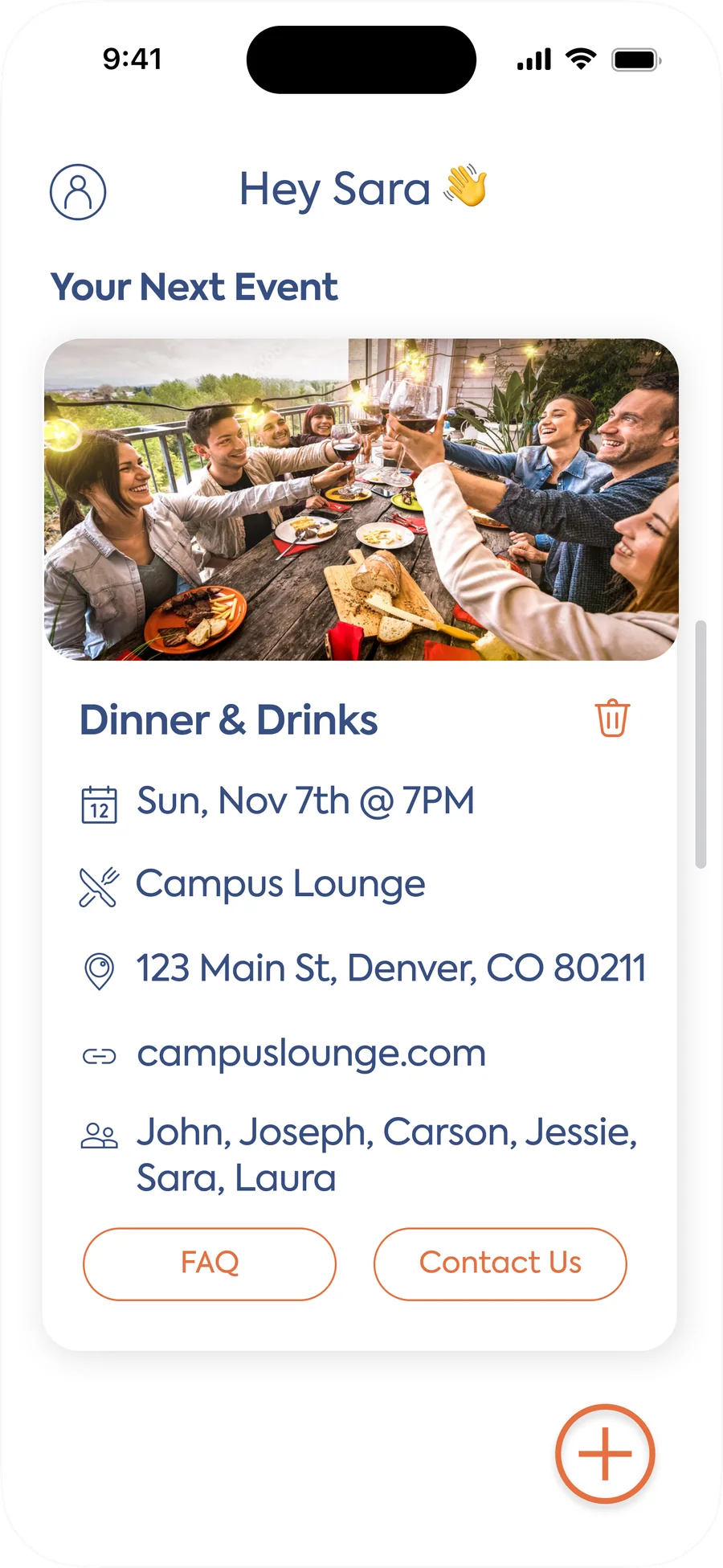
Countdown, then revealTurns waiting into anticipation. Details land when plans are real.
Option CReveal on the dayToo stressful. People need time to plan travel.
Tradeoff I acceptedMore support questions in the gap, so FAQ and Contact Us live right on the card.
Signal I watchedLate cancellations and no-shows.
D4Decision
Make the survey required.
The question: How do we get honest signal about who clicked?
Option AOptional surveyIndustry norm. Response rates would have starved matching.
Option BAsk in person, at the tableAwkward and public. The opposite of safe.
Option CCHOSEN
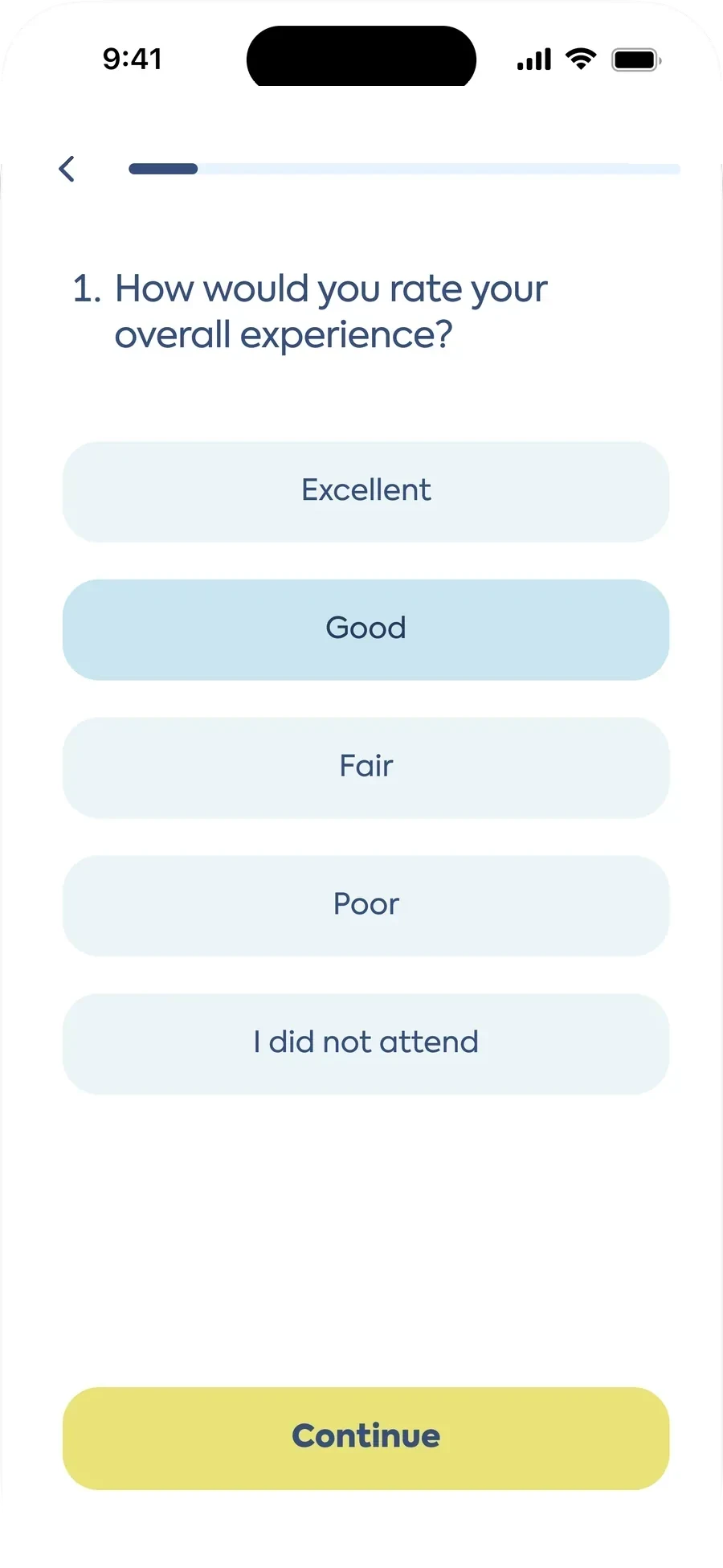
Required, short, adaptiveGated the next booking, ended early for no-shows, branched on answers.
Tradeoff I acceptedA gate is friction. I kept it under a minute and framed it as a thank-you.
Signal I watchedCompletion rate and time to complete.
How the survey branches
Q1 RatingExcellent → Poor
→
Q2 Why?Reworded per rating
→
Q3 HeadcountWho showed up
→
Q4 VenueRate the place
→
Q5 PeopleSee again · no-show · no
→
ThanksMatches in a week
↳ “I did not attend”→
End surveyNo feedback from absentees
D5Decision
Mutual or nothing.
The question: How should a connection become a friendship?
Option AFollow anyone you metOne-sided. Turns rejection into something visible.
Option BCHOSEN
Mutual match, then chatNobody sees a “no.” A yes from both sides unlocks a friend.
Tradeoff I acceptedFewer connections overall, but every one of them is wanted.
Signal I watchedMatches that lead to a message within a week.
They: yesThey: noYou: yes
Friend unlockedChat opens, grouped again
Nothing shown
You: no
Nothing shown
Never grouped again
The consent model
Three of four outcomes show nothing at all. Nobody ever sees a “no.”
Iteration: an earlier friends list put a chat icon on every row. It implied obligation, so I removed it and made the whole row the target.
Design system
One small system, built for warmth and speed.
As the sole designer I built Commonly’s brand and component system, so two engineers could ship every screen from the same parts. Rounded shapes and one butter-yellow action per screen keep the app friendly and the next step obvious.
Ink navy#3B4A8C · Text, headings, icons
Butter#E9E37A · Primary actions
Coral#E8743F · Secondary actions, alerts
Mist#EAF3F6 · Fields, choice chips
White#FFFFFF · Cards, surfaces
Type: one rounded geometric sans, three weights. Components: pill buttons, choice chips, date rows, event cards.
ContinueContact Us🍳 CookingGood · selectedSunday, Feb 5th @ 12PM
04Impact
Two bets held. One needed a fix.
Beta in late 2023 (180 members) compared with the first year in Denver (1,400 members, 760 events).
NORTH STAR · CAME BACK
34%→%
of members booked a second event within 30 days of their first. This was the number the reframe was about.
Mutual match by 3rd event58%+37 ptsfrom 21%, vs. after just one event
Post-event survey completion89%+54 ptsfrom 35%, optional in beta → required at launch
No-show rate6%−11 ptsfrom 17%, after adding the late-cancel fee
H1 · Commit to threeHELD
Members who booked three dates attended 2.3× as many events as one-at-a-time bookers.
H2 · No profilesHELD AFTER A FIX
Sign-up completion dipped 6 points without profiles. It recovered once the guarantee card answered “what if I don’t click with anyone?”
H3 · Required surveyHELD
89% completion, with a median time of 48 seconds and no rise in support tickets.
Each yellow line is two people who both said “yes.” More events, more friendships.
05Retro
What I’d do differently.
Test the survey soonerIt carries the whole matching model. I would have tested wording with real groups before polishing home.
Instrument the gapI under-measured the days between booking and dinner, where most doubt lives.
Design for hostsVenues and hosts shape the night more than any screen. They deserved their own tools.
The best screen in this app is the one you close to go to dinner.
After: the table empties, and two people leave as friends.